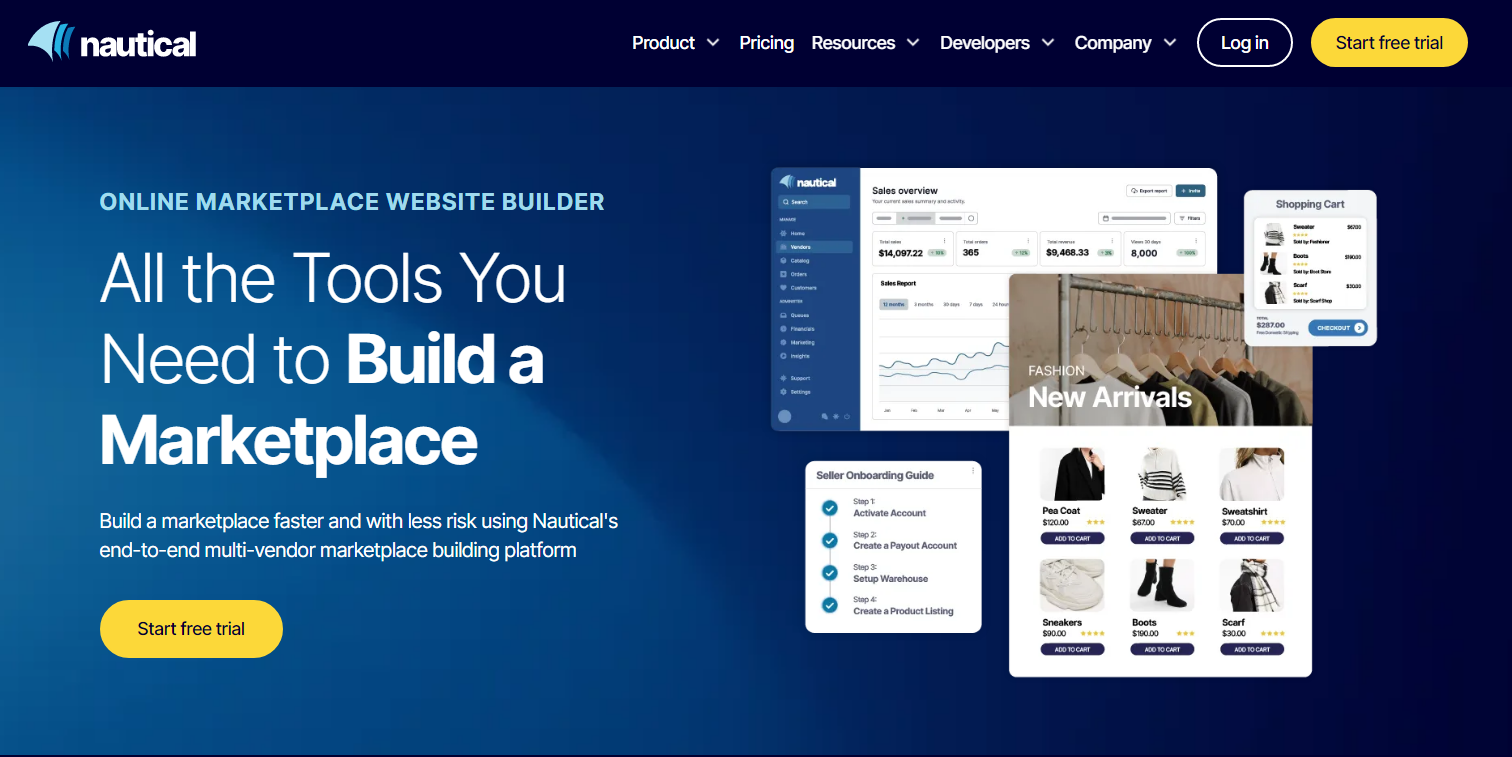
Nautical Commerce raised $30M from Drive Capital to build marketplace-as-a-service — the infrastructure layer for companies launching multi-vendor marketplaces without building payments, catalogs, and vendor management from zero. When we joined, the codebase was a year old, written fast the way funded codebases are, and the company needed it to become something enterprises would sign for.
The role
I ran our side of the engagement as its technical program lead — a team of seven engineers embedded into Nautical's organization, with me curating the whole program: what we took on, who did it, how it was reviewed, and what the client heard from us and when. Project managers ran the day-to-day mechanics; I coached the leads, held the quality bar, and stayed the escalation path in both directions — when Nautical needed something to move, and when my engineers needed something unblocked.
This is a different shape of work from owning a product outright. Embedded in someone else's engineering org, half the job is technical and half is organizational: making seven external engineers feel — to the client's own team — like colleagues rather than a vendor. The measure of whether that worked isn't mine to give, but Nautical's head of engineering later left a public review calling us the best experience he'd had with an offshore team, and I'll take that verdict over any I could write.
What we did
The inherited frontend wasn't going to carry an enterprise product, so we rebuilt it. Then the work that turns a marketplace demo into marketplace infrastructure: payment processing, multi-currency, multi-language, and tax logic — the four features every founder underestimates because each one is a lattice of edge cases wearing a one-line label. Tax logic across jurisdictions alone is a program of work, not a ticket.
The second arc was hardening: taking the platform enterprise-grade and SOC 2 ready. SOC 2 readiness is mostly invisible engineering — access controls, audit trails, process discipline — and it's exactly the kind of work that dies without program-level ownership, because no individual sprint ever feels like the one where compliance matters. Keeping that arc moving alongside feature delivery was, more than anything else, what my role was for.
At scale, the platform was processing over 200,000 transactions a month. Nautical's assets were later acquired by Traide.
What this engagement taught me
Rescue framing undersells what this work actually is. The one-year-old codebase wasn't broken — it was appropriate for its age, and the mistake most teams make is declaring bankruptcy on code that simply hasn't been asked to be enterprise software yet. We rebuilt what genuinely couldn't carry the load (the frontend) and evolved everything else in place. Knowing which is which is the judgment call the whole engagement rests on, and it's a program decision, not a pull request.
And on embedded teams: the vendor-client boundary is exactly as visible as you allow it to be. Every process we ran — reviews, standups, escalations — was designed so the boundary disappeared. When it works, the client's head of engineering writes the review ours got.
Engagement: 7 embedded engineers · Frontend rebuild, payments, multi-currency, multi-language, tax logic · Enterprise-grade, SOC 2 ready · 200K+ monthly transactions · Client raised $30M from Drive Capital; assets later acquired by Traide.