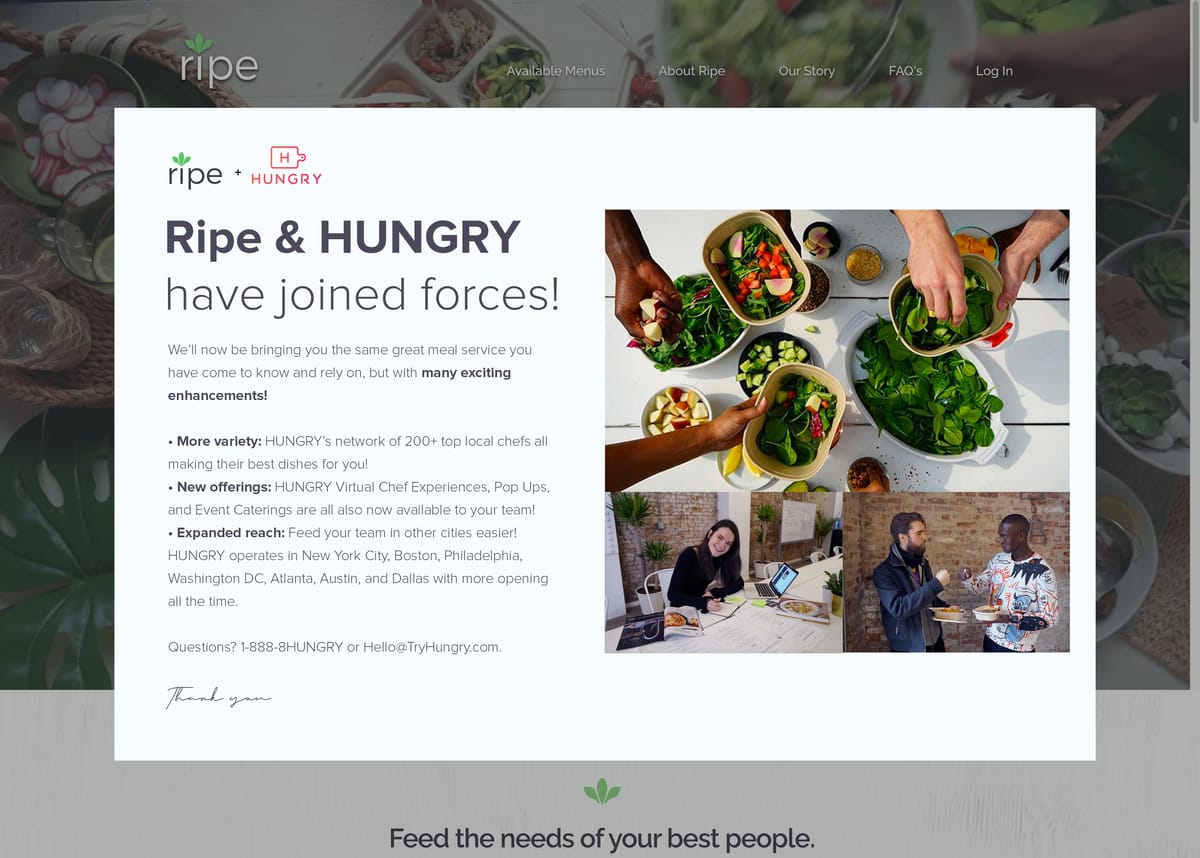
Ripe was a real business before we wrote a line of code. A functioning catering operation in Manhattan with a kitchen, drivers, and a customer list that included DigitalOcean, MongoDB, and Kickstarter — companies that paid every week for lunch, not for software. In 2016 the founders decided the operation needed a platform, and that's where I came in.
The role
I wasn't the one writing the code, and this post won't pretend otherwise. My job was everything around the code: I ran the engagement as its technical program lead — scoping what would get built and in what order, assembling and coaching the team, owning the client relationship, and making the calls when something had to give. Project managers handled the routine ceremonies. I made sure nothing important ever became routine.
That distinction matters for how a project like this survives five years. Engineers rotate, priorities shift, a catering company's Tuesday crisis is never in the sprint plan. The constant was the program: one person accountable for the whole arc, from the first architecture conversation to the diligence data room.
What we built
The platform covered the entire operation, because a catering business is an operation first: ordering for the corporate customers, kitchen workflows so the food actually got made in the right sequence, delivery tracking so it arrived, and billing so Ripe got paid. Four systems that each look simple on a whiteboard and none of which are simple when the kitchen is live at 10am and the client's lunch is at noon.
We built it from scratch in 2016 and then did the less glamorous thing: supported it for five years. Real support — the product evolving with the business, not a maintenance retainer. At steady state the platform was processing over a thousand orders a week.
The exit
In 2020, Hungry — a larger food-tech marketplace — moved to acquire Ripe. Acquisitions of software-enabled businesses come with technical due diligence, which is the one moment an outside team reads your codebase with money on the line and no reason to be polite.
Hungry's team went through the platform. They liked what they found. The acquisition closed in September 2020.
I think about that as the real deliverable of the engagement. Not the launch — launches are easy to celebrate and forget. Five years later, a skeptical third party audited the work product and it held up well enough to close a deal on. That's the standard I run programs to: build as if someone will eventually read this with a checkbook in hand, because someone eventually did.
What I'd tell the 2016 version of this engagement
Treat the kitchen as the primary user. The corporate customers had the money, but the operation lived or died on whether the people making and moving food trusted the system. Every hour spent watching the actual workflow paid back tenfold in what we didn't build.
And keep the program continuous. The projects that decay are the ones where leadership attention arrives in bursts — at kickoff and at crisis. Ripe had neither burst, which is why it had a quiet, clean exit instead.
Engagement: 2016–2021 · Platform: ordering, kitchen operations, delivery tracking, billing · 1,000+ weekly orders · Acquired by Hungry, September 2020, following technical due diligence.